OK. I'll admit it: We are, by nature, procrastinators. And I mean that in the nicest way. Quite frankly, we are adrenalin junkies. Until the pressure is on, we are distracted and less than productive.
And so we waited for some signal, like Paul Revere: "One if by land, two if by sea." And while our shot may not have been "heard around the world", it still reverberates in my ears.
One loud shot. A wake up call. Only the message was not delivered by Paul Revere. Instead, it was UPS. Our trees arrived Friday: 8 boxes...600 trees!
And so, the pressure is on. The water tank is in place. The plumbing is ongoing.
We are scrambling to locate tree tubes and limestone, and of course, shovels. And for the next week, like the Patriots, we will be caught up in battle, because mother nature is playing some very strange tricks on us with the weather.
So we will labor in the sun for the next few days, and then we will probably freeze for a while. But whatever the weather, those trees will go in the ground.
That's the thing about procrastinators: They tend to get things done.
Tuesday, March 13, 2007

Monday, February 12, 2007
Ripping Time!
We finally had some nice-ish weather last week so I went out and staked out the truffle farm area for Pat, the tractor guy. The soil was perfect for ripping so, after Pat, a master gardener, gave me his two cents' worth on how to start a truffle farm, he finally went to work tilling the field:
 He's a shy guy and didn't want me taking pictures of him so I had to hide in the barn and shoot through the dirty window. In case you're looking for a tractor guy, Pat's the kind you want. He has long hair, smokes incessantly, likes cash, and isn't afraid of a little hard work.
 His little tractor (a John Deere 70) did quite well but I think we'll use one with bigger rippers to do the final pass before we plant. Still, it got everything fluffed up and confirmed that we have nice, loamy soil to work with. We also picked up a bunch of garbage - beer bottles, old car parts, various pipes, and even and old black and yellow California license plate from 1963 - and some huge rocks that I'll use around the yard for landscaping some day.
I also found a local nursery that will do free soil testing. It's a strange day when you get excited about that sort of thing...
 He's a shy guy and didn't want me taking pictures of him so I had to hide in the barn and shoot through the dirty window. In case you're looking for a tractor guy, Pat's the kind you want. He has long hair, smokes incessantly, likes cash, and isn't afraid of a little hard work.
 His little tractor (a John Deere 70) did quite well but I think we'll use one with bigger rippers to do the final pass before we plant. Still, it got everything fluffed up and confirmed that we have nice, loamy soil to work with. We also picked up a bunch of garbage - beer bottles, old car parts, various pipes, and even and old black and yellow California license plate from 1963 - and some huge rocks that I'll use around the yard for landscaping some day.
I also found a local nursery that will do free soil testing. It's a strange day when you get excited about that sort of thing...
Tuesday, February 6, 2007
2007 Oregon Truffle Festival Recap
We headed up to Eugene , Oregon the other weekend to attend the Cultivation Seminar at the Second Annual Oregon Truffle Festival. The seminar and festival were put together by Dr. Charles LeFevre, who we are purchasing our 600 truffle-infused trees from, and his associates up there. They did a terrific job of organizing and kept us busy for three days straight so kudos to them.
As for us budding truffle farmers, we learned a lot from our wonderful instructors, Dr. Carlos Colinas and Christine Fischer, but less than expected in cultivation seminar as a whole. What we mostly learned is that cultivation is so new, especially in the U.S., that no one can really give you a straight answer on anything. Or, perhaps, no one wants to be liable for giving an answer that may eventually be proven incorrect. So we basically learned that anything may be possible in the world of tuber melanosporum cultivation aka truffle farming and that if you want to learn more you should just dive right in and find out if it works for you.
That said, we did meet a lot of nice and interesting people at various stages of their truffle farming endeavors. Some are dreamers, some are planners, some are a few years in, some have a few trees, some 400 trees, some no trees. We learned that you train a trufflehound like you'd train a drug-sniffing dog, and that virtually any breed with stamina will work (we're already arguing over what types of dogs to get even though our trees haven't arrived!). We also learned that the truffle cultivation seminar may be something to attend only once, then plant, and then wait a few years until you see how your farm is doing, then return for the grower's forum if you have questions, or answers to help others along.
Best of all for us, we finally saw, smelled and tasted our first truffles!
Here we are getting our very first whiff of a french black truffle recently harvested in Tennessee of all places! I'd like to offer the disclaimer that we don't normally look that strange and that the unphotogenic gene runs in the family...
Either way, I think the picture reflects our trepidation and dismay at the crop we're banking on. Neither of us appears to have the palate to appreciate a $1,000 piece of fungus, which will probably be helpful as we won't be sneaking truffles behind eachother's backs. Call me simple but I would choose a box of Cheez-Its over a 4 ounce truffle any day.
Still, at least we now know what they look, and smell, like. Here is a picture of the infamous tuber melanosporum, aka Perigord or french black truffle, that we will be growing:

And here it is up close and sliced in half. You can see the marble-like appearance that means it's ripe. It has an earthy but potent smell that makes me wonder how anyone ever felt the need to dig up this little, smelly dirt-clod looking thing and place it in their mouth. As I said, I'm simple...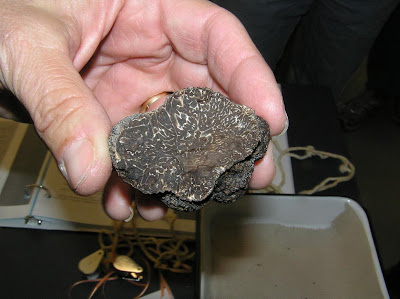 We ate that one soon after the photo was taken. It was grated into some excellent Spanish olive oil and drizzled on some bread slices. Personally, I think I liked the olive oil more than the truffle. I guess I'm still cultivating my hoity toity-ness.
Oregon has its own native truffles known as the Oregon white and Oregon black truffles. Here is a picture of the oregon white truffle:
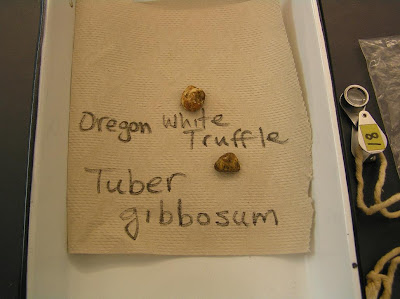 Seeing as how we truffle queens both live off the power grid and rely on propane for heat, we immediately recognized the pungent odor of garlicky propane being emitted from these dime-sized tubers. After making this observation a scientist informed us that the Oregon white truffle odor does indeed have the same chemical structure as the scent they add to propane and would be in the propane family of odors. Two points to the truffle queens for recognizing noxious odors!
We saw some other types of truffles, looked in microscopes at micorryzhae (which look like little corn dogs), and after two days of learning about truffle history and farming, left feeling fairly confident in our endeavor as we appeared to have the climate and soil most similar to where the truffles are found in Spain, France and Italy.
After spending Friday and Saturday in class, we attended the Grand Truffle Dinner with 298 other food and truffle afficionados. The meal had an appetizer, three courses, and a dessert, all of which were prepared by James Beard award winning chefs and included truffles. Here is what our menu consisted of:
 In the end we had fun, met lots of interesting people, and got a zillion ideas for experiments to conduct as we start our truffle farm this month. We also formed a Yahoo Group because everyone said they wanted to keep in touch. Of course, no one has joined yet. If you want to join or check it out, you can click on the link to the right.
Next up: Setting up the farm, complete with pictures!
As for us budding truffle farmers, we learned a lot from our wonderful instructors, Dr. Carlos Colinas and Christine Fischer, but less than expected in cultivation seminar as a whole. What we mostly learned is that cultivation is so new, especially in the U.S., that no one can really give you a straight answer on anything. Or, perhaps, no one wants to be liable for giving an answer that may eventually be proven incorrect. So we basically learned that anything may be possible in the world of tuber melanosporum cultivation aka truffle farming and that if you want to learn more you should just dive right in and find out if it works for you.
That said, we did meet a lot of nice and interesting people at various stages of their truffle farming endeavors. Some are dreamers, some are planners, some are a few years in, some have a few trees, some 400 trees, some no trees. We learned that you train a trufflehound like you'd train a drug-sniffing dog, and that virtually any breed with stamina will work (we're already arguing over what types of dogs to get even though our trees haven't arrived!). We also learned that the truffle cultivation seminar may be something to attend only once, then plant, and then wait a few years until you see how your farm is doing, then return for the grower's forum if you have questions, or answers to help others along.
Best of all for us, we finally saw, smelled and tasted our first truffles!
Here we are getting our very first whiff of a french black truffle recently harvested in Tennessee of all places!
 I'd like to offer the disclaimer that we don't normally look that strange and that the unphotogenic gene runs in the family...
Either way, I think the picture reflects our trepidation and dismay at the crop we're banking on. Neither of us appears to have the palate to appreciate a $1,000 piece of fungus, which will probably be helpful as we won't be sneaking truffles behind eachother's backs. Call me simple but I would choose a box of Cheez-Its over a 4 ounce truffle any day.
Still, at least we now know what they look, and smell, like. Here is a picture of the infamous tuber melanosporum, aka Perigord or french black truffle, that we will be growing:

And here it is up close and sliced in half. You can see the marble-like appearance that means it's ripe. It has an earthy but potent smell that makes me wonder how anyone ever felt the need to dig up this little, smelly dirt-clod looking thing and place it in their mouth. As I said, I'm simple...
 We ate that one soon after the photo was taken. It was grated into some excellent Spanish olive oil and drizzled on some bread slices. Personally, I think I liked the olive oil more than the truffle. I guess I'm still cultivating my hoity toity-ness.
Oregon has its own native truffles known as the Oregon white and Oregon black truffles. Here is a picture of the oregon white truffle:
 Seeing as how we truffle queens both live off the power grid and rely on propane for heat, we immediately recognized the pungent odor of garlicky propane being emitted from these dime-sized tubers. After making this observation a scientist informed us that the Oregon white truffle odor does indeed have the same chemical structure as the scent they add to propane and would be in the propane family of odors. Two points to the truffle queens for recognizing noxious odors!
We saw some other types of truffles, looked in microscopes at micorryzhae (which look like little corn dogs), and after two days of learning about truffle history and farming, left feeling fairly confident in our endeavor as we appeared to have the climate and soil most similar to where the truffles are found in Spain, France and Italy.
After spending Friday and Saturday in class, we attended the Grand Truffle Dinner with 298 other food and truffle afficionados. The meal had an appetizer, three courses, and a dessert, all of which were prepared by James Beard award winning chefs and included truffles. Here is what our menu consisted of:
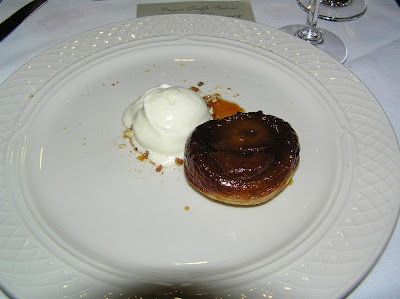
AMUSE BOUCHE - Tuna Crudo with Celery-Anchovy Salad & Truffle Vinaigrette (By Chefs Stephanie Pearl Kimmel & Rocky Maselli of Marche in Eugene)In my opinion, the amuse bouche, first course (my favorite!!!) and dessert were awesome. The second course was okay and I like the idea of a timbale (a mashed potato plop in the center of a bowl of gravyish soup). The third course looked terrible on a white plate and my chicken inside the pastry was dry but I did like the little chicken legs surrounding it as they were tasty. Then again, I'm not a food critic or even close to being a gourmet so take that how you will. Either way, here's my only clear picture of the dessert, which was way better than it looks:
FIRST COURSE - Oregon Dungeness Crab Salad with Black Truffles, Apples & Shell Beans (By Chef Vitaly Paley of Paley's Place in Portland)
SECOND COURSE - Timbale of Fingerling Potatoes & Truffles with a Potage of Leeks & Root Vegetables (By Chef Greg Higgins of Higgins Restaurant & Bar in Portland)
THIRD COURSE - Papillotte of Coquelet with Truffle Port Compote & Celeriac Mousseline (By Chef Philippe Boulot of The Heathman in Portland)
DESSERT - Truffle Pear Tarte Tatin with Sour Cream Puff Pastry, Roasted Hazelnuts & Truffle-Honey Ice Cream By Chefs Cory Schreibner, Michelle Vernier & Dustin Clark of Wildwood in Portland.
 In the end we had fun, met lots of interesting people, and got a zillion ideas for experiments to conduct as we start our truffle farm this month. We also formed a Yahoo Group because everyone said they wanted to keep in touch. Of course, no one has joined yet. If you want to join or check it out, you can click on the link to the right.
Next up: Setting up the farm, complete with pictures!
Wednesday, January 24, 2007
How we got the idea to cultivate expensive mushrooms
It all started a few years back when my mom, Diana, was looking for real estate in Kern County where she could raise her menagerie of animals on what would one day become Windswept Ranch. She and husband David somehow got the idea that they might invest in some real estate wherein they could both raise exotic animals and grow hoity toity mushrooms, a natural combination. Unfortunately, such an estate was not available in the desired price range so they settled for just being exotic animal ranchers in the town of Twin Oaks, California.
Flash forward six years to when I, Kassandra the daughter, decided people in southern California were going crazy and paying too much for real estate and so decided to cash out my vast 1/2 acre mobile home/house hybrid and flee to Kern County to start a new life. I moved to a ranchette off the power grid on 6 acres just outside the small mountain town of Tehachapi , California.
Soon enough the lot next door to my house came up for sale and, greedy for solitude and mountain views like this:
 I bought an additional 3.5 acres.
While contemplating what to do with the new acreage, my mother remembered her dreams (hallucinations?) of becoming a truffiere and our plan was hatched: We would form a dynamic mother-daughter duo and become the Truffle Queens of Tehachapi.
With the decision made and the land in hand, we of course turned to the internet for all our truffle growing needs. That's where we found Dr. Charles Lefevre at New World Truffieres who had no problem convincing us that two brown thumbs should most certainly invest thousands of dollars in a truffle farm. We promptly ordered 600 trees infused with the French black truffle fungus spore.
Now it's January and truffle planting season is upon us. Of course, the one trait common to this mother-daughter duo is procrastination. Just as soon as we return from the Oregon Truffle Festival this weekend, where we intend to learn everything we need to know about growing truffles (and taste our first truffles), we'll get started on the farming aspect. Really, we mean it!
In the meantime, my pig Hogitha is on guard, watching over the future truffiere:

Flash forward six years to when I, Kassandra the daughter, decided people in southern California were going crazy and paying too much for real estate and so decided to cash out my vast 1/2 acre mobile home/house hybrid and flee to Kern County to start a new life. I moved to a ranchette off the power grid on 6 acres just outside the small mountain town of Tehachapi , California.
Soon enough the lot next door to my house came up for sale and, greedy for solitude and mountain views like this:
 I bought an additional 3.5 acres.
While contemplating what to do with the new acreage, my mother remembered her dreams (hallucinations?) of becoming a truffiere and our plan was hatched: We would form a dynamic mother-daughter duo and become the Truffle Queens of Tehachapi.
With the decision made and the land in hand, we of course turned to the internet for all our truffle growing needs. That's where we found Dr. Charles Lefevre at New World Truffieres who had no problem convincing us that two brown thumbs should most certainly invest thousands of dollars in a truffle farm. We promptly ordered 600 trees infused with the French black truffle fungus spore.
Now it's January and truffle planting season is upon us. Of course, the one trait common to this mother-daughter duo is procrastination. Just as soon as we return from the Oregon Truffle Festival this weekend, where we intend to learn everything we need to know about growing truffles (and taste our first truffles), we'll get started on the farming aspect. Really, we mean it!
In the meantime, my pig Hogitha is on guard, watching over the future truffiere:

Subscribe to:
Posts (Atom)

